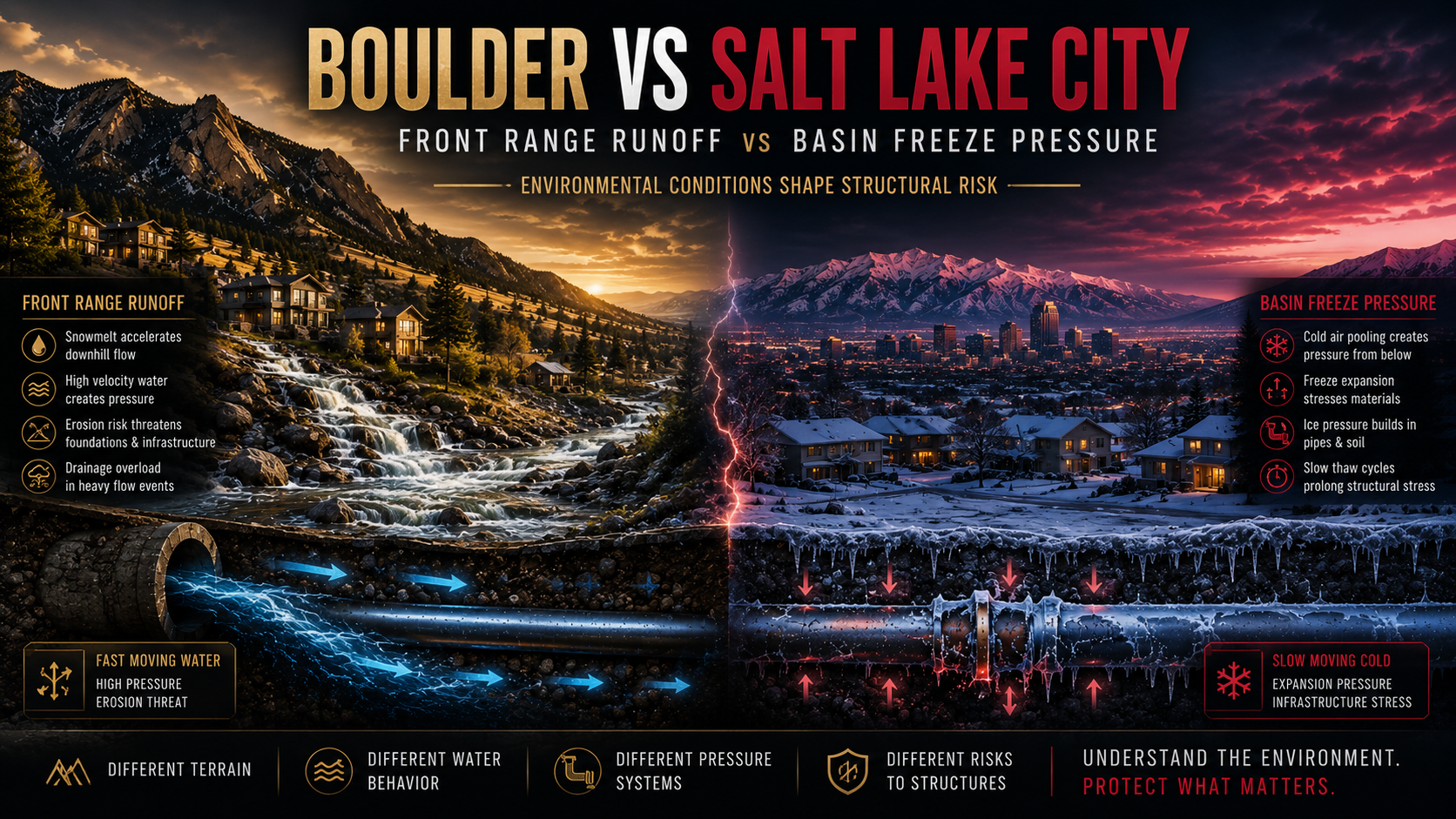
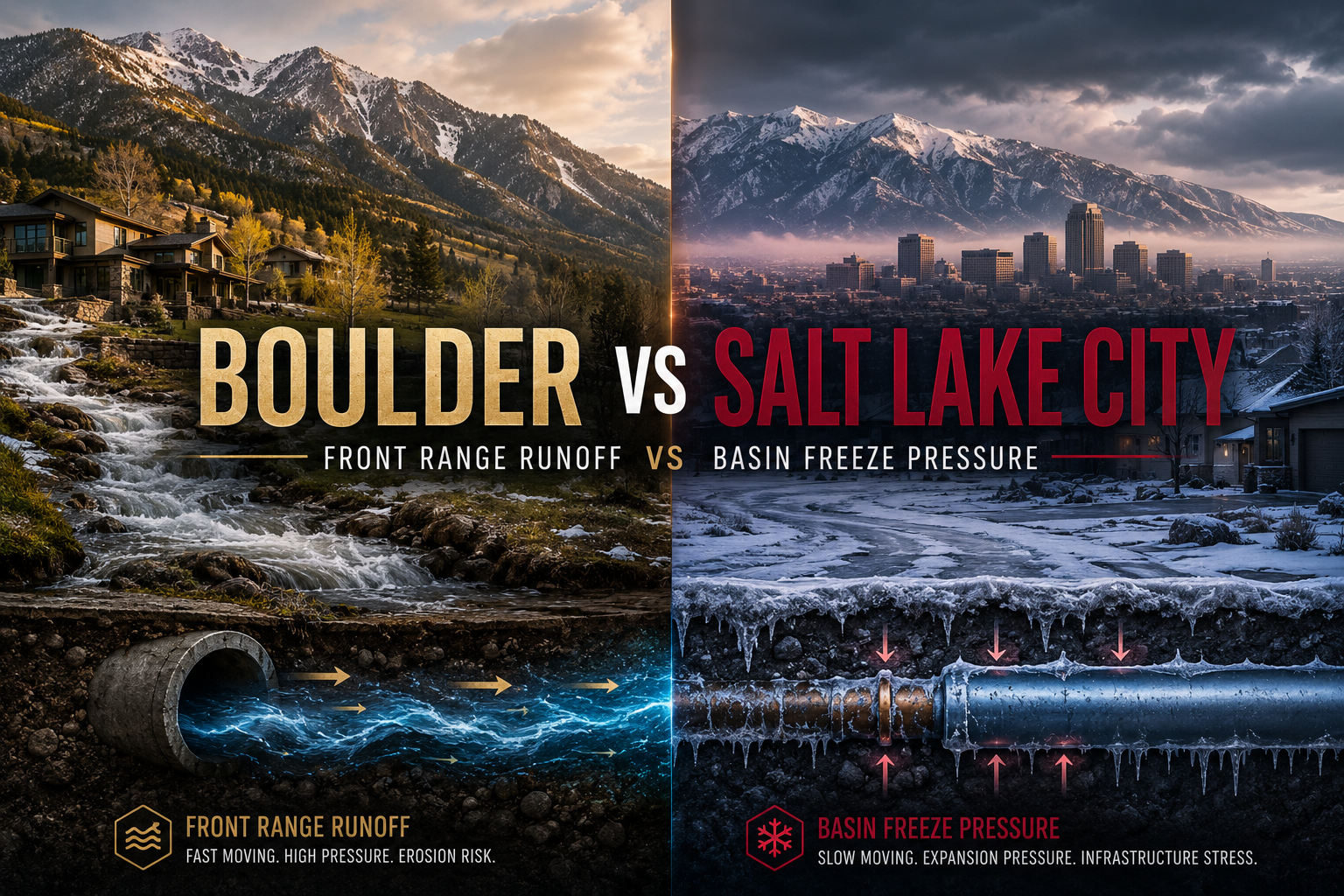
Boulder vs Salt Lake City — Front Range Runoff vs Basin Freeze Pressure
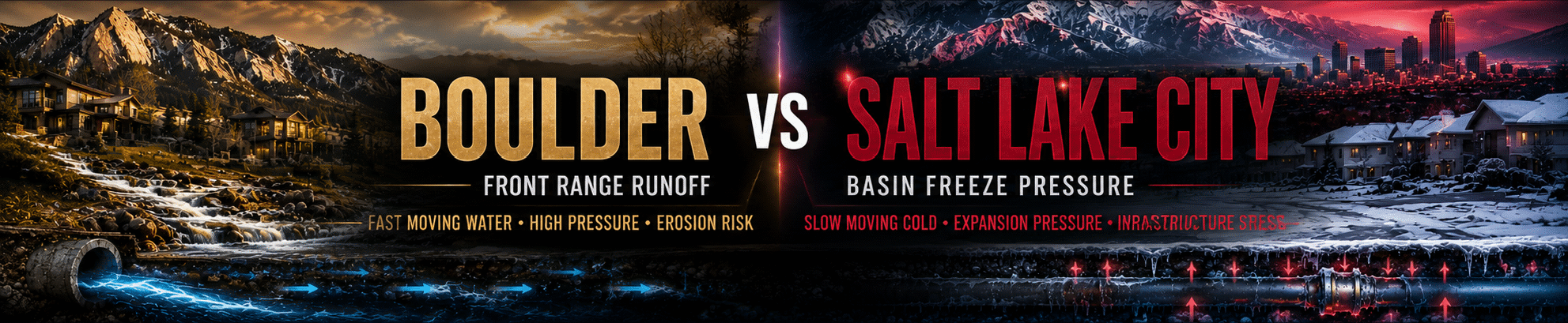
Some cold-climate environments create pressure through elevation movement. Others slowly trap winter stress inside basin systems surrounded by mountains.
Boulder and Salt Lake City both sit beneath dramatic mountain backdrops shaped by snowpack, winter exposure, runoff migration, and recurring freeze-thaw movement. But the environmental pressure systems affecting structures behave very differently over time.
Along Colorado’s Front Range, winter pressure moves aggressively. Snowmelt drains downhill through foothill corridors, temperatures swing rapidly between daytime thawing and overnight refreezing, and structures repeatedly expand and contract during fast-moving freeze-thaw cycles.
Along the Wasatch Front, winter pressure behaves differently. Cold air settles into basin environments for longer periods, snowpack often lingers deeper into seasonal transitions, and prolonged inversion conditions allow saturation and freeze pressure to remain trapped near structural systems for extended periods of time.
One environment plays fast.
The other plays heavy.
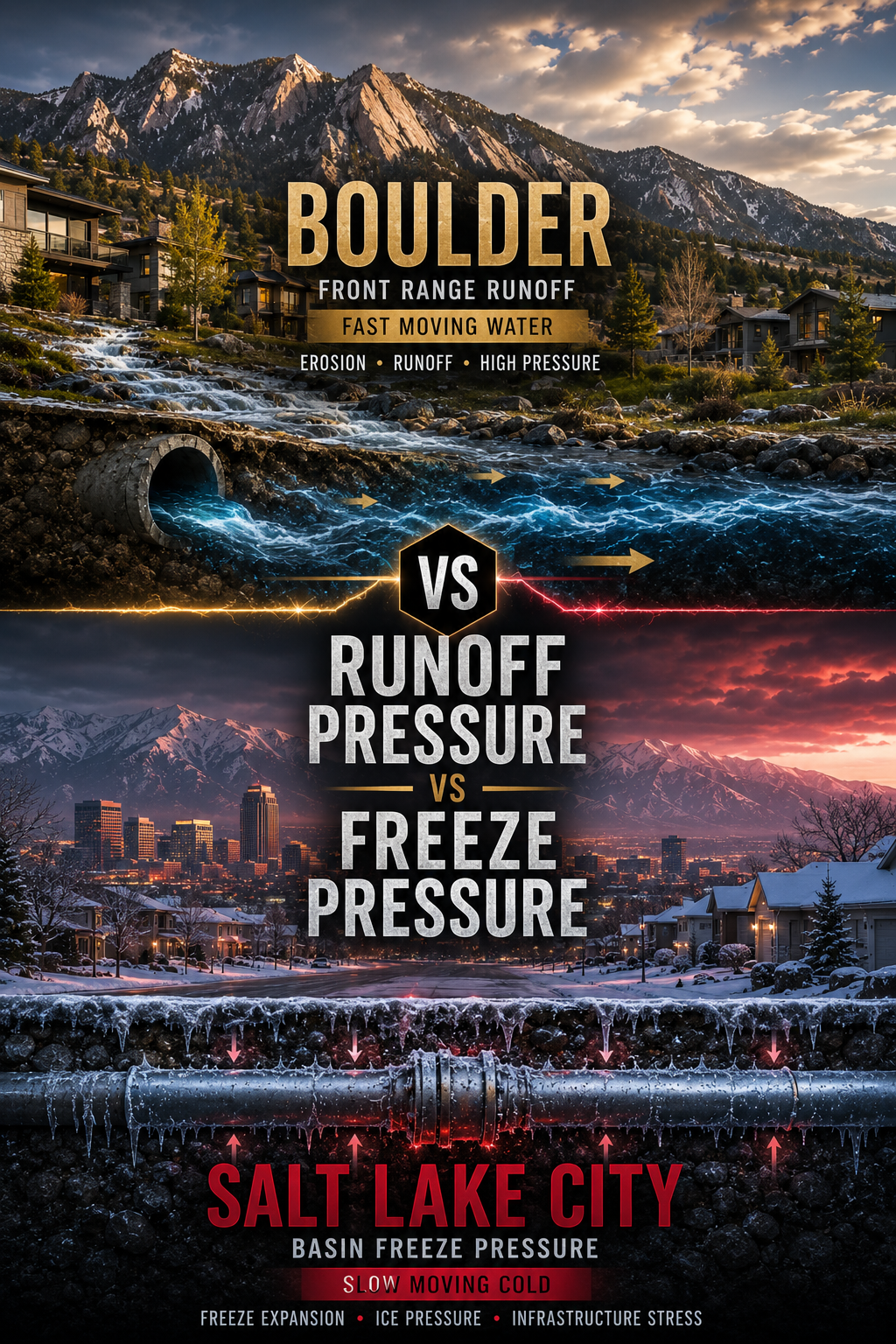
Structural Environment Breakdown
Front Range Runoff Systems
Boulder-area environments commonly experience:
- rapid freeze-thaw cycling
- foothill runoff concentration
- aggressive daytime snowmelt
- thermal expansion swings
- slope drainage pressure
- rapid environmental fluctuation
- snowpack migration through elevation corridors
- recurring hillside saturation
Front Range systems rarely stay static for long.
Temperatures shift quickly.
Moisture moves quickly.
Pressure redistributes quickly.
That repeated environmental movement gradually stresses:
- foundations
- retaining systems
- exterior wall assemblies
- drainage pathways
- slab systems
- plumbing corridors
- structural joints
The pressure is built through movement.
Not prolonged retention.
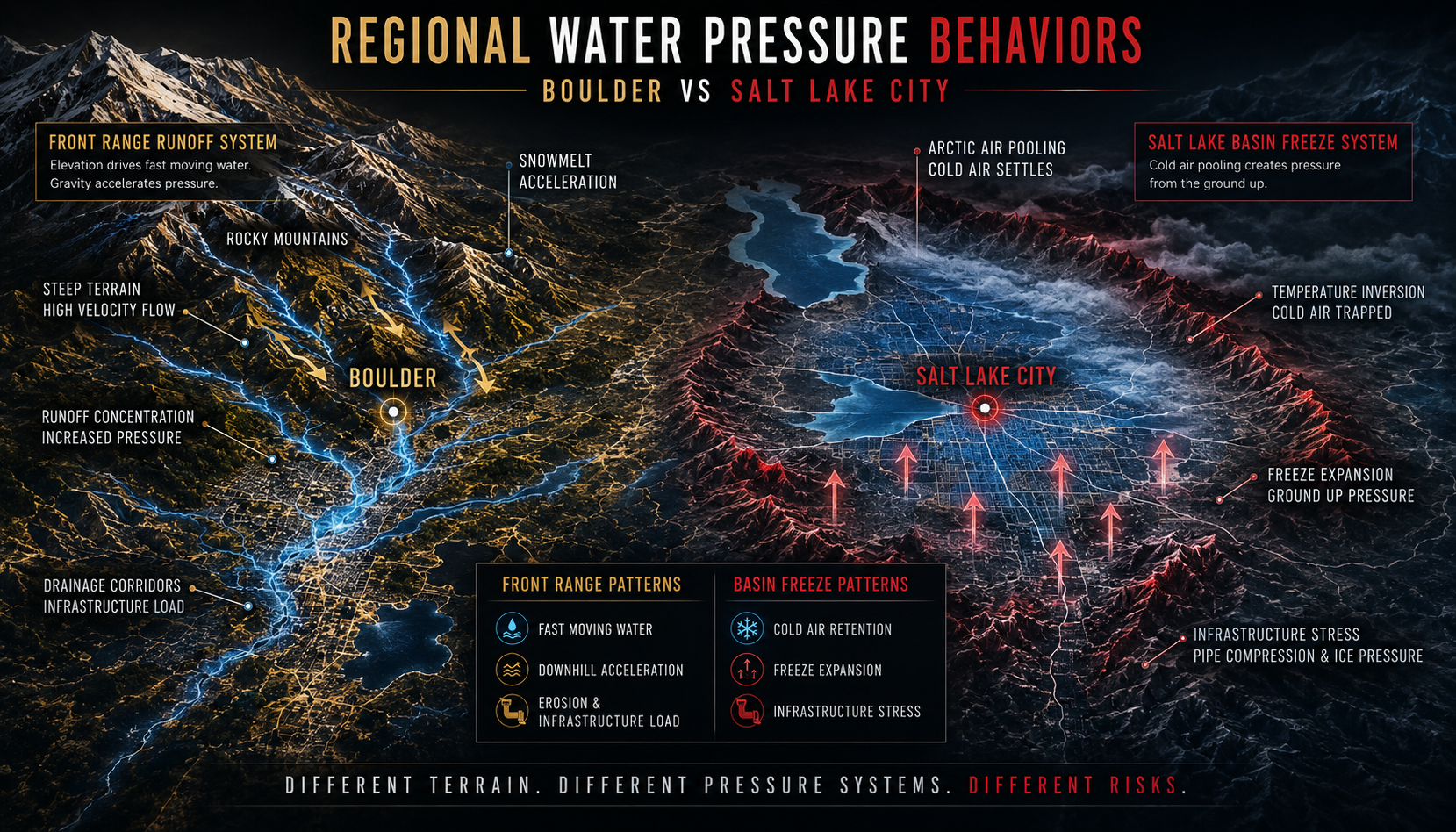
Basin Freeze Pressure Systems
Salt Lake City-area environments more commonly experience:
- basin inversion pressure
- prolonged freeze retention
- extended snowpack accumulation
- cold-air trapping conditions
- recurring saturation buildup
- slower thaw progression
- thermal contraction stress
- long-duration environmental pressure
Unlike the Front Range, basin environments often allow winter conditions to settle and remain in place longer.
That slower environmental pacing gradually increases:
- hidden moisture retention
- foundation pressure
- cavity saturation
- freeze-related contraction stress
- drainage fatigue
- long-duration structural exposure
The pressure builds quietly.
But heavily.
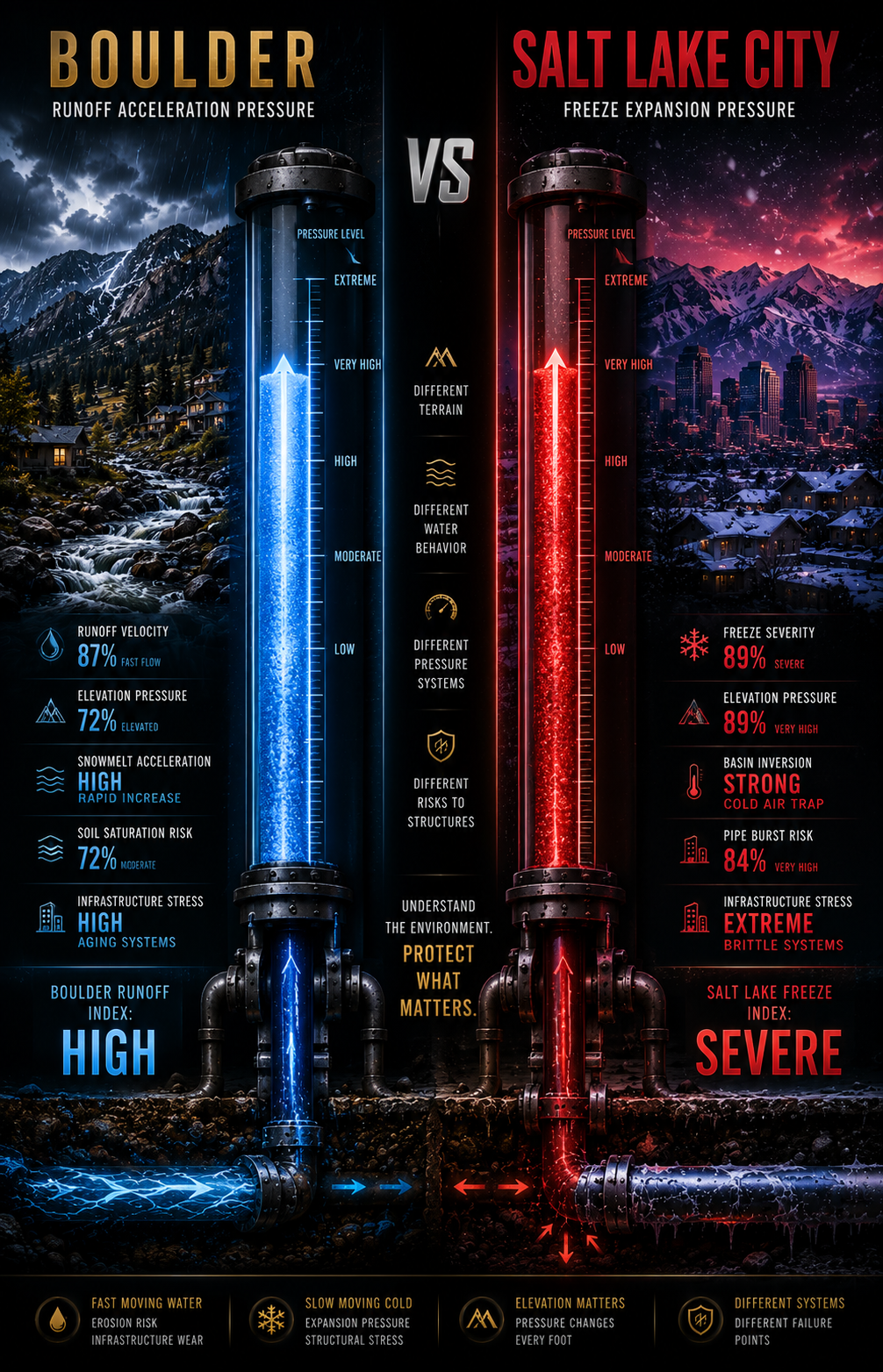
Movement vs Containment
One of the biggest differences between these environments is how winter pressure behaves once moisture enters the system.
Front Range environments are dominated by:
- runoff movement
- elevation drainage
- rapid thermal shifts
- aggressive thaw cycles
- environmental fluctuation
Basin freeze environments are more heavily influenced by:
- cold-air containment
- slower saturation release
- prolonged snow retention
- sustained winter pressure
- recurring moisture persistence
In mountain runoff environments, moisture keeps moving downhill.
In basin environments, pressure often settles and lingers longer around structures.
That distinction quietly changes how homes age over time.
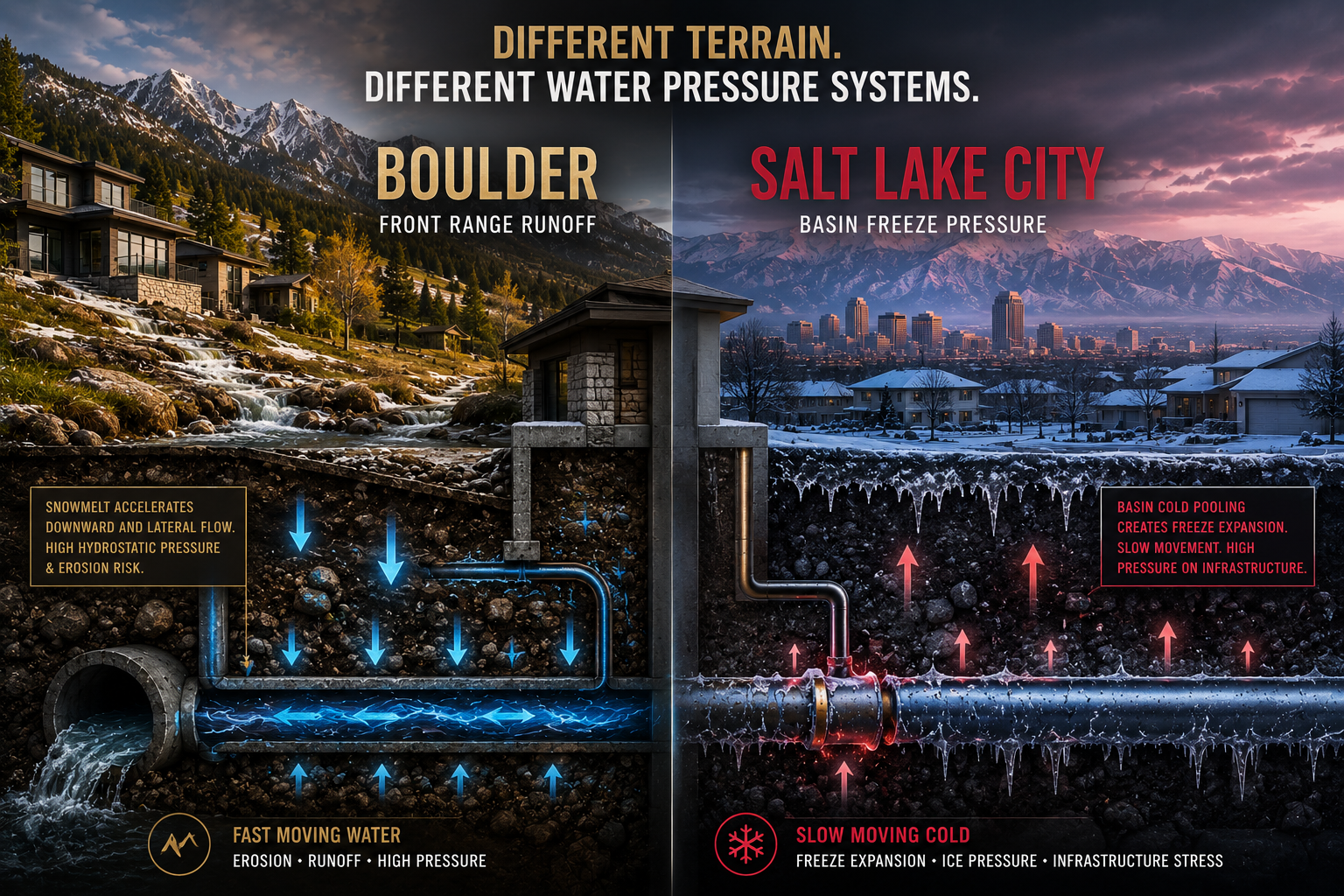
Structural Fatigue Across Elevation Systems
Most freeze-related structural damage develops gradually through recurring seasonal pressure rather than a single winter event.
Over time, repeated exposure to:
- thermal movement
- runoff migration
- snowpack saturation
- freeze-thaw expansion
- prolonged contraction
- environmental moisture retention
slowly increases structural fatigue across both regions.
Along the Front Range, the environmental stress is tied more closely to rapid movement and thermal fluctuation.
Along basin systems, structural stress becomes more tied to sustained winter pressure and long-duration saturation retention.
Different styles.
Different pacing.
And different forms of environmental fatigue.
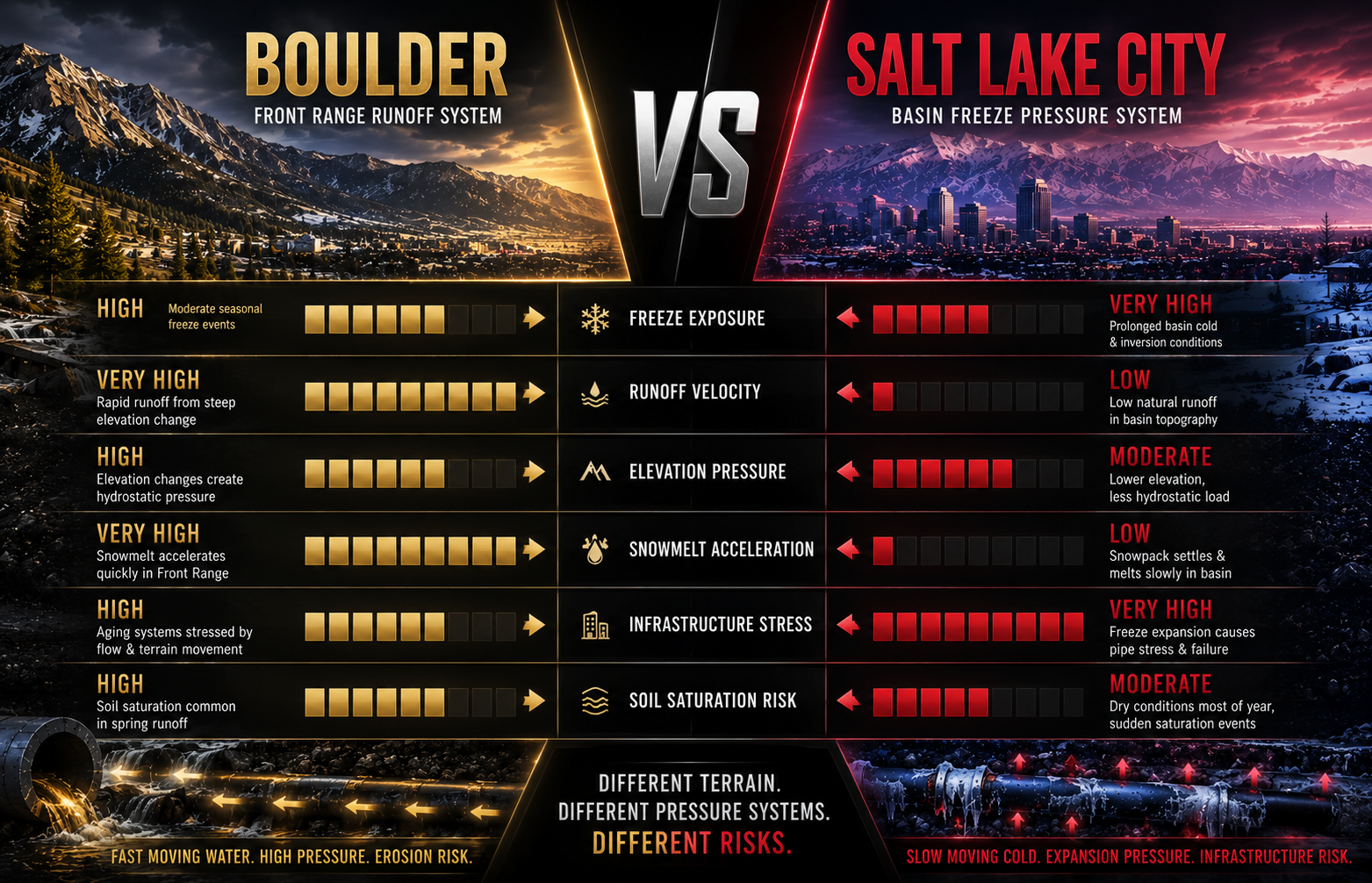
Snowpack Pressure Scoreboard
Boulder Front Range Systems
- Rapid freeze-thaw cycling
- Aggressive runoff migration
- Foothill drainage pressure
- Thermal expansion swings
- Dynamic environmental movement
- Recurring snowmelt saturation
Salt Lake City Basin Systems
- Basin inversion pressure
- Prolonged freeze retention
- Extended snowpack accumulation
- Long-duration saturation pressure
- Thermal contraction stress
- Persistent winter environmental exposure
Structural Matchup Analysis
This matchup highlights how two mountain environments can produce completely different forms of winter structural pressure despite sharing:
- elevation exposure
- snowpack accumulation
- freeze-thaw movement
- mountain runoff systems
- recurring winter saturation
Front Range environments behave more like:
- fast-paced runoff systems
- aggressive thermal cycling corridors
- dynamic elevation pressure zones
Basin freeze environments behave more like:
- sustained winter pressure systems
- cold-air containment regions
- long-duration saturation corridors
Both environments create serious structural stress.
They simply apply pressure differently.
Environmental Tempo & Winter Pressure
Some winter systems create pressure through speed and movement.
Others create pressure through duration and accumulation.
Along the Front Range:
- runoff accelerates quickly
- temperatures swing rapidly
- snowmelt shifts constantly
- structures repeatedly expand and contract
Inside basin environments:
- cold settles deeper
- snowpack lingers longer
- saturation releases slower
- winter exposure remains elevated for extended periods
One system attacks vertically through movement.
The other leans on sustained environmental weight.
Featured Structural Matchups
Related environmental comparisons include:
- Denver vs Minneapolis — Elevation Runoff vs Deep Freeze Cycles
- Denver vs Buffalo — Front Range Snowmelt vs Lake-Effect Saturation
- Denver vs Green Bay — Freeze Cycling vs Deep Freeze Infrastructure Fatigue
- Denver vs Chicago — Mountain Drainage vs Freeze-Belt Basement Saturation
- Tahoe vs Colorado Rockies — Sierra Snowpack vs High-Elevation Freeze Cycling
Mountain & Freeze-Thaw Pressure Regions
The environmental systems discussed throughout this matchup commonly affect Colorado, Utah, Wyoming, Montana, Idaho, Nevada mountain regions, California mountain regions, Oregon, Washington, Minnesota, Wisconsin, Illinois, Michigan, Ohio, Pennsylvania, New York, Vermont, New Hampshire, Maine, and other cold-climate states exposed to snowpack accumulation, freeze-thaw cycling, mountain runoff, basin inversion pressure, and recurring winter environmental stress.
These environmental systems frequently affect:
- mountain communities
- hillside developments
- high-elevation neighborhoods
- snowpack runoff corridors
- freeze-climate suburbs
- basin environments
- luxury mountain properties
- aging cold-weather infrastructure
Many of the structural movement patterns, runoff behaviors, snowpack pressure systems, and hidden winter moisture conditions discussed throughout this matchup evolve gradually over decades as structures absorb repeated environmental pressure through freeze exposure, runoff migration, snowmelt saturation, thermal cycling, basin retention, and recurring seasonal movement.
